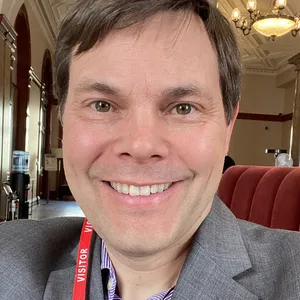
Principal Investigator
Prof. Cédric John
College of Earth, Ocean and Atmospheric Sciences, Oregon State University, USA
- 133
- Peer-reviewed publications
- 201
- Conference abstracts
- 53
- Invited talks
- $15.4M
- Research funding raised
My research sits where machine learning meets the geosciences, but it started with rocks: carbonate platforms, palaeoclimate records, cores recovered by scientific ocean drilling, and the clumped isotope geochemistry of carbonates. Geology has traditionally been a descriptive science, and much of what we know comes from observations that are slow to make and that experienced geologists do not always interpret in the same way. I see machine learning as a way to make these interpretations faster and more consistent, at least where the training data are well understood. However, AI is only as good as the geology behind it. The Research page describes our current themes, and Geological roots explains where they come from.
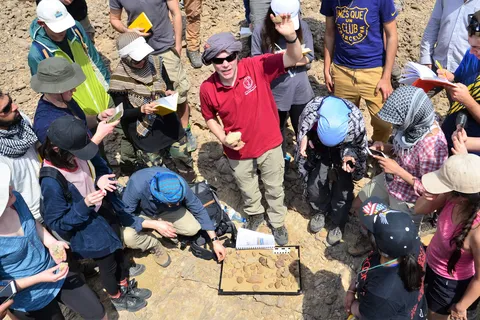
In our group, numerical work and observation go together. We pair machine learning and numerical modelling with laboratory measurements, fieldwork and ocean-going expeditions, so that our models learn from data we understand and are tested against the ground truth of the outcrop and the core. Many of the problems we work on come from industry, where descriptive data are used every day to make decisions about the subsurface. Over the years we have worked closely with QatarEnergy, Shell, TotalEnergies, Aramco, ExxonMobil and BP, through long-term research centres, consortia and industry-funded PhDs. This dialogue keeps our research relevant, and our funding reflects it.
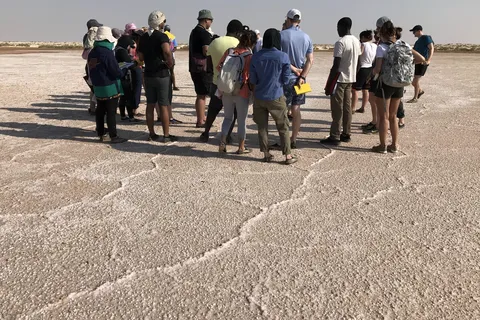
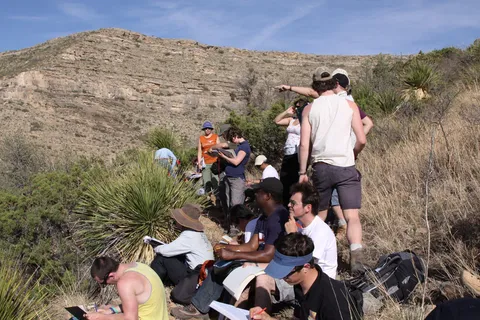
Teaching follows the same logic. I have designed and taught courses from introductory stratigraphy and carbonate systems to machine learning for geoscientists and data science at master's level, and I have led field courses in Oman and in the Permian Basin of Texas and New Mexico. Students who will build models of the Earth need to have seen the rocks, and geologists increasingly need to write code. I try to give each group the tools of the other. The courses are described on the Teaching page.
Career
-
1999–2003
Miocene climate and carbonate platforms
University of Potsdam, Germany
After a diploma at the University of Neuchâtel with Karl Föllmi, on phosphatic hardgrounds of the Monterey Formation in California, I did my PhD with Maria Mutti on how middle Miocene climate shaped carbonate systems in the Mediterranean (Malta) and on the Marion Plateau off northeast Australia. Sailing as a sedimentologist on ODP Leg 194 in 2000, alongside Gregor Eberli and Garry Karner, was my introduction to scientific ocean drilling.
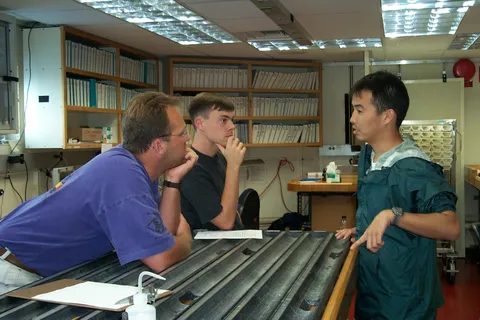
Discussing cores on ODP Leg 194, 2000 -
2004–2005
The Paleocene–Eocene Thermal Maximum
University of California, Santa Cruz
As a postdoc with Jim Zachos, I studied the Paleocene–Eocene Thermal Maximum, the abrupt warming of about 56 million years ago, and what shallow continental-margin records along North America reveal about climate and surface runoff at the time. It taught me to read sediments as recorders of the carbon cycle as well as of sea level.
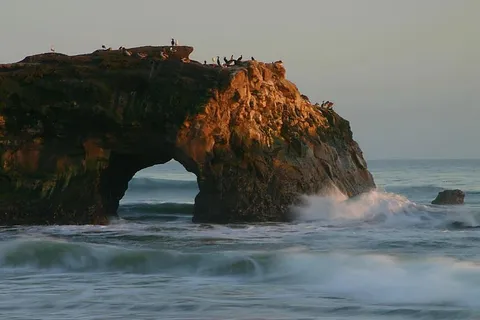
Natural Bridges, Santa Cruz -
2006–2008
Running ocean-drilling expeditions
Integrated Ocean Drilling Program, Texas A&M University
As a staff scientist and Expedition Project Manager, I organised and sailed scientific drilling cruises, including the hydrological flow experiments of IODP Expedition 308 in the Gulf of Mexico (which I first sailed in 2005 as a temporary staff scientist), and worked alongside the NanTroSEIZE experiments of our partners in Japan. It was a lesson in large, multi-disciplinary science, and in the caveats of working with cores and subsurface data.
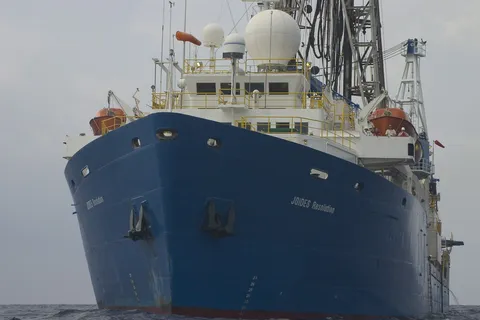
The drillship JOIDES Resolution -
2008–2018
Carbonates and clumped isotopes
Department of Earth Science and Engineering, Imperial College London
I joined Imperial as a Lecturer in Carbonate Reservoirs and, within the Qatar Carbonates and Carbon Storage Research Centre (funded by QatarEnergy, Shell and Qatar Science & Technology Park), set up one of the early laboratories for carbonate clumped isotope (Δ47) paleothermometry. We built an automated sample-extraction line (IBEX), released open-source software for clumped isotope data (Easotope) and calibrated the thermometer from 25 to 250 °C.
With a growing team of students and postdocs, we used it to reconstruct burial temperatures, dolomitisation, fracture fluids and past ocean temperatures, and combined it with fieldwork on reservoir analogues in Oman and the UAE.
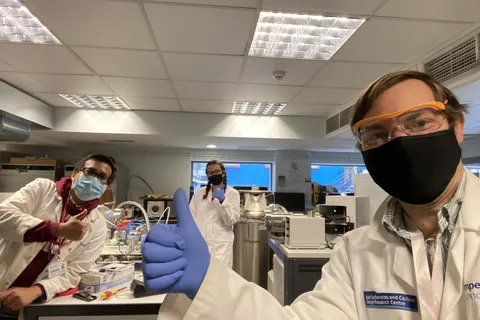
In the laboratory at Imperial -
2018–2024
The turn to AI
Department of Earth Science and Engineering, Imperial College London
By the late 2010s I was convinced that geology's bottleneck was no longer a lack of data but the time and subjectivity involved in interpreting it. As Reader in Earth-Centric AI, I moved the group towards machine learning: neural networks that classify carbonate cores and thin sections, generative models for borehole images, and Earth observation of reefs and of Mars. I was Deputy Director of two MSc programmes in machine learning for geoscience and the environment, and led the I-X Planet research activity.
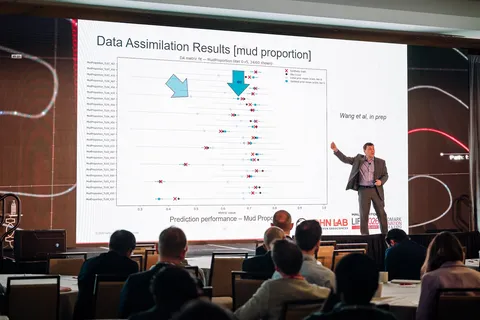
Presenting the lab's data-assimilation work -
2024–2026
Data science for the environment
Digital Environment Research Institute, Queen Mary University of London
At DERI I headed the Data Science for the Environment and Sustainability platform, which broadened the group's work to weather and climate forecasting and to partnerships beyond geology: an AI-based early-warning initiative for rainfall with the Government of Sierra Leone, and a doctoral and master's scholarship programme with Indonesia's agency for meteorology, climatology and geophysics (BMKG).
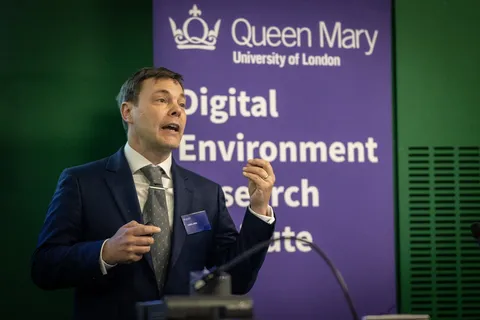
Speaking at the Digital Environment Research Institute -
2026–present
Bringing it together
College of Earth, Ocean and Atmospheric Sciences, Oregon State University
At Oregon State I am bringing these threads together: AI that is grounded in the physics and observations of the Earth system, close to the ocean-going science where my career began. I keep visiting professorships at Queen Mary University of London (to 2031) and at Imperial College London.
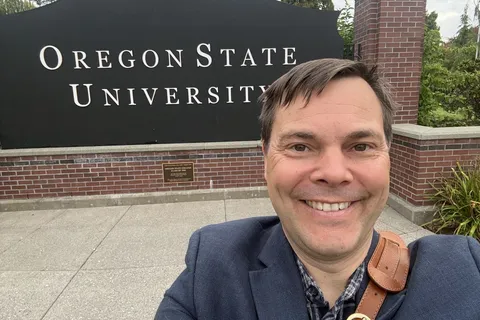
Oregon State University
Leadership
-
2024–2026
Lead, Government of Sierra Leone and QMUL joint initiative for climate change
Queen Mary University of London
-
2024–2026
Board member, Academy for Excellence in AI Teaching
Queen Mary University of London
-
2023–2024
Coordinator, BMKG Indonesian studentship programme
Imperial College London, then Queen Mary University of London
-
2023
Theme Lead, Data Science and AI
Department of Earth Science and Engineering, Imperial College London
-
2021–2023
Deputy Director, MSc programmes GEMS and EDSML
Imperial College London
-
2020–2023
Team Lead, I-X Planet research activity
Imperial College London
-
2017–2022
Lead, Mental Health Advisory Team
Department of Earth Science and Engineering, Imperial College London
Recognition
Editorial roles
- 2025–present Editor (solid Earth), Journal of Geophysical Research: Machine Learning and Computation · American Geophysical Union
- 2019–2022 Associate Editor, Geochimica et Cosmochimica Acta · Elsevier
Distinguished lectureships
- 2026 Distinguished Speaker and Invited Visiting Professor · Universiti Tenaga Nasional (UNITEN), Malaysia
- 2025–2026 AAPG Distinguished Lecturer · American Association of Petroleum Geologists
- 2024–2025 ECORD Distinguished Lecturer · European Consortium for Ocean Research Drilling
Visiting and named professorships
- 2026–2027 Halbouty Visiting Professor, Department of Geology and Geophysics · Texas A&M University
- 2026–2031 Visiting Professor, Digital Environment Research Institute · Queen Mary University of London
- 2024–present Visiting Professor, Department of Earth Science and Engineering · Imperial College London
Awards
- 2024 Top 5 team, AI in Enhanced Weather Forecasting Hackathon (IEEE Region 8 Climate Challenges) · IEEE
- 2018 President's Award for Research Team (co-recipient, Qatar Carbonates and Carbon Storage Research Centre) · Imperial College London
- 2015 Norman Falcon Award for best paper in Petroleum Geoscience (co-recipient) · European Association of Geoscientists and Engineers
Service to the community
- 2022–2023 Academic advisor, Young Professionals AI Committee · SPE London Section
- 2021–2024 Member, Special Interest Committee on Artificial Intelligence · European Association of Geoscientists and Engineers
- 2019–2022 Panel member, UK Geology degree accreditation review board · Geological Society of London
- 2018–2024 Founding Member and Trustee · Diversity in Geoscience UK (DiG-UK)
- 2012–2013 Member, Science Evaluation Panel · Integrated Ocean Drilling Program
- 2009–2010 Member, Scientific Technology Panel · Integrated Ocean Drilling Program